
A White Paper on the 5D Strategic Planning Canvas
2026©Mohammed Raei
Executive Summary
Strategic planning is one of the most institutionalized practices in contemporary organizations, yet it remains one of the most persistently disappointing. Across corporate, public, nonprofit, educational, and healthcare sectors, organizations invest substantial time, financial resources, and political capital into strategic planning cycles. These cycles produce vision statements, mission declarations, multi-year strategic plans, portfolios of initiatives, and increasingly sophisticated performance dashboards. Despite this, a recurring pattern emerges: strategy often has limited influence on everyday decision-making, fails to shape organizational behavior in sustained ways, and rapidly becomes obsolete in the face of complexity and uncertainty.
This white paper introduces the 5D Strategic Planning Canvas, a grammar-level approach to strategy derived from the transdomain, non-integrative 5D metatheory. The core argument advanced here is that many strategic failures originate not from poor execution, insufficient leadership commitment, or inadequate data, but from upstream design errors embedded in unexamined assumptions about reality, knowledge, value, action, and purpose. Conventional strategy frameworks tend to operate downstream of these assumptions, implicitly accepting them as given and focusing instead on optimizing decisions within a pre-constructed world.
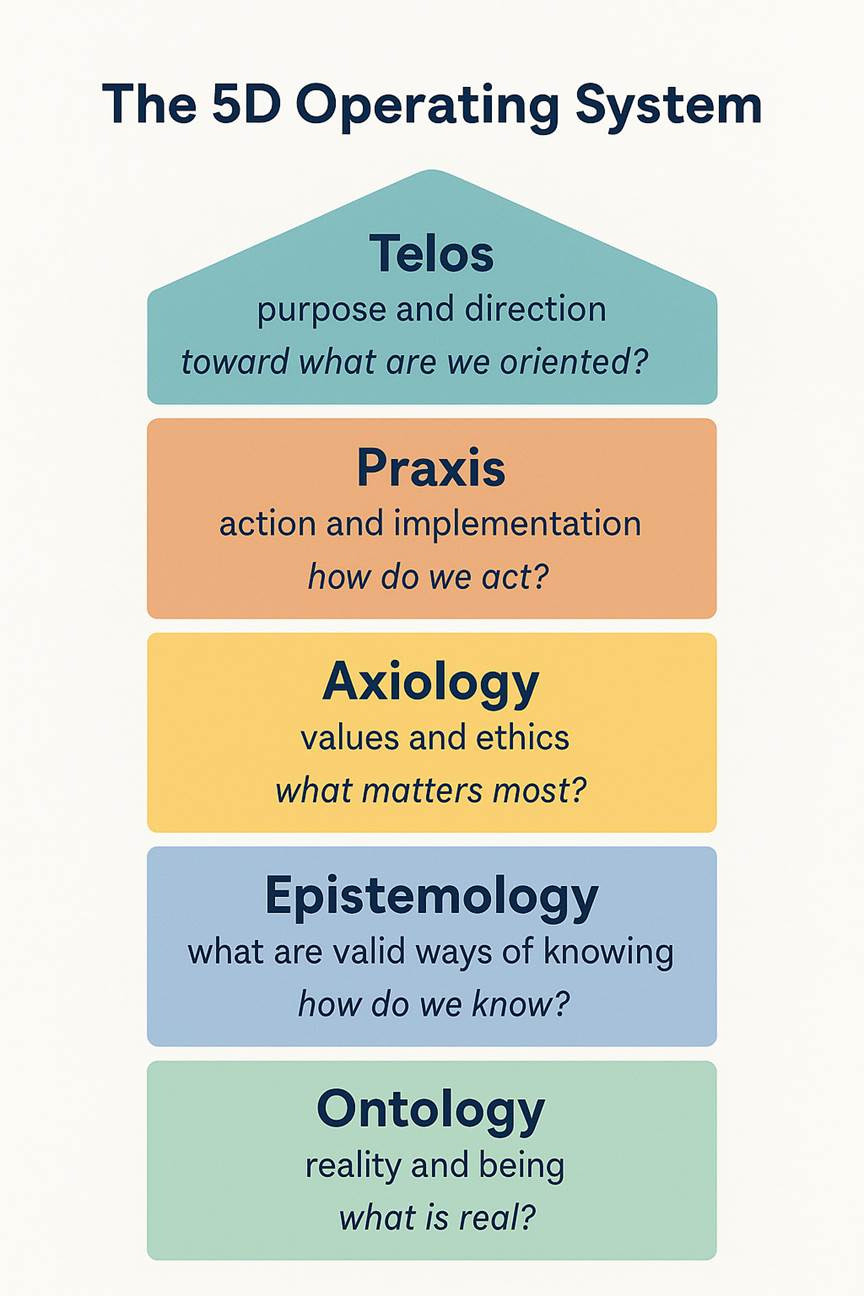
The 5D Strategic Planning Canvas reframes strategy from the production of plans, goals, and metrics to the design of the conditions under which meaningful strategy becomes possible at all. It makes explicit five irreducible dimensions that are always present in strategy, whether acknowledged or not:
- Ontology (assumptions about what kind of system exists),
- Epistemology (assumptions about how knowledge and evidence are generated and legitimized),
- Axiology (assumptions about what is valued and rewarded),
- Praxis (assumptions about what actions and interventions are legitimate), and
- Telos (assumptions about directionality and the space of possible futures).
These dimensions are treated not as sequential steps in a planning process, but as lateral constraints that shape and limit one another simultaneously. By making these constraints explicit, the 5D Canvas enables pre-execution diagnosis of strategy quality, exposes category smuggling, prevents the collapse of values into metrics, and allows plural yet coherent strategies to coexist without forced integration. Because it operates at the level of grammar rather than content, the canvas is domain-agnostic and portable across sectors.
In an era characterized by complexity, uncertainty, and transdomain challenges, this paper argues that strategy must evolve from optimizing actions within assumed worlds to designing the grammatical conditions that determine what actions, values, and futures can meaningfully exist.
1. The Persistent Limits of Contemporary Strategic Planning
Strategic planning has become deeply embedded in organizational life. Organizations without formal strategies are often perceived as reactive, poorly governed, or lacking legitimacy. As a result, strategic planning has become ritualized through annual retreats, consultant-led processes, multi-year planning cycles, and formal governance requirements. In many sectors, producing a strategy document is less about guiding action and more about signaling competence, accountability, or alignment with external expectations.
Despite this institutionalization, dissatisfaction with strategic planning is widespread. Leaders frequently report that strategy feels disconnected from operational realities, overly abstract, or quickly overtaken by events. Employees often experience strategy as something that happens elsewhere, translated into shifting priorities and metrics without a clear sense of coherence or meaning. Boards and oversight bodies receive strategy updates that demonstrate activity but provide limited insight into whether the organization is moving in a genuinely desirable direction.
Common explanations for strategic failure typically focus on execution. Strategies, it is argued, are sound in principle but poorly implemented due to resistance to change, lack of accountability, insufficient incentives, or weak communication. While these factors are real, they are often secondary. They presume that the strategy itself is conceptually coherent and that the primary challenge lies in translating it into action. This presumption is rarely examined.
What is far less frequently addressed are the foundational assumptions that structure strategy itself. Every strategy rests on implicit answers to questions such as: What kind of system are we operating in? What counts as valid knowledge? What is worth optimizing? What kinds of actions are legitimate? What direction is assumed to be desirable? When these assumptions remain implicit, they exert powerful influence while remaining largely invisible.
As a result, organizations often respond to strategic failure by revising plans, adding metrics, reorganizing structures, or launching new initiatives, while leaving the underlying grammar of strategy untouched. This produces cycles of reform that address surface-level symptoms without altering the conditions that generate them.
2. Strategy as Content Versus Strategy as Grammar
The dominant conception of strategy treats it as content. Strategy is understood as a set of choices: which markets to enter, which priorities to pursue, which initiatives to fund, and which metrics to track. Strategic work is therefore focused on analysis, prioritization, and alignment. The quality of a strategy is judged by its clarity, internal consistency, and apparent feasibility.
The 5D Strategic Planning Canvas introduces a fundamentally different conception. It treats strategy as grammar rather than content. Grammar does not dictate what must be said; it defines what can be said meaningfully. It establishes the structural rules that render certain expressions intelligible and others incoherent. Similarly, strategic grammar does not prescribe specific goals or actions. Instead, it defines the conditions under which certain strategies are possible, legitimate, or even thinkable.
This shift from content to grammar moves strategic attention upstream. Instead of asking which strategy to choose, organizations are invited to ask what assumptions make certain strategies appear reasonable while rendering others invisible or illegitimate. Strategic grammar shapes what counts as realistic, responsible, or strategic. It operates through language, metrics, governance structures, and decision rules. Because it is taken for granted, it is rarely examined directly.
By making strategic grammar explicit, the 5D Canvas enables a different kind of strategic work. Rather than optimizing within inherited constraints, organizations can consciously design the conditions under which strategy unfolds. This allows coherence to be assessed before execution, rather than discovered through failure.
3. The Five Irreducible Dimensions of Strategy
The 5D Strategic Planning Canvas rests on the premise that five dimensions are irreducible. None can be derived from another, and none can be collapsed without distortion. These dimensions are always present in strategy, even when they are not explicitly named.
Ontology
Ontology concerns assumptions about what kind of system exists. Is the organization understood as a machine to be optimized, a market actor competing for advantage, a complex adaptive system, a living organism, or a symbolic community? Each ontological stance carries different implications for control, prediction, and intervention.
Ontological errors occur when strategies optimized for one kind of system are applied to another. Treating educational institutions, healthcare systems, or communities as if they were factories or markets often leads to unrealistic expectations, inappropriate performance measures, and counterproductive interventions.
Epistemology
Epistemology concerns how knowledge is generated, validated, and used. Strategic decisions rely on indicators, models, forecasts, narratives, and judgments. Epistemic failure occurs when representations are mistaken for reality or when uncertainty and ambiguity are denied rather than acknowledged.
By separating epistemology from ontology, the 5D Canvas allows organizations to examine whether their ways of knowing are adequate to the systems they seek to influence. A complex adaptive system may require different epistemic practices than a stable, mechanistic one.
Axiology
Axiology concerns value. Values are enacted through incentives, resource allocation, promotion criteria, and recognition systems. Even when values are not explicitly articulated, they shape behavior powerfully. The absence of explicit axiology does not produce neutrality; it produces hidden normativity.
The 5D Canvas does not prescribe which values should be chosen. Instead, it makes values structurally unavoidable and inspectable, allowing organizations to examine the alignment between what they claim to value and what they actually reward.
Praxis
Praxis concerns action: routines, interventions, capabilities, and practices. Many strategy processes over-emphasize praxis, leading to action bias and premature execution. The 5D Canvas situates praxis as one dimension among others, constrained by ontology, epistemology, axiology, and telos.
This reframing slows action down not to inhibit it, but to ensure that action is coherent with the assumptions that make it meaningful.
Telos
Telos concerns directionality. It is not equivalent to goals or targets. Telos refers to the directional pull that constrains the space of meaningful futures. Growth, efficiency, stability, or impact often function as default teloi without being consciously chosen.
By making telos explicit, the canvas allows organizations to examine whether their direction is coherent with their assumptions about reality and value, and whether alternative directions might be equally or more legitimate.
4. The Canvas as a Simultaneous Constraint System
The five dimensions of the 5D Canvas do not operate sequentially. They form a simultaneous constraint system in which each dimension shapes and limits the others laterally. There is no correct starting point and no single dimension that can dominate without distortion.
For example, a finite ecological ontology constrains a telos of unlimited growth. A complex adaptive ontology constrains the epistemic legitimacy of mechanistic performance metrics. A pluralistic axiology constrains single-metric optimization. These constraints are not problems to be eliminated but conditions to be navigated.
By making these constraints explicit, the canvas enables pre-execution diagnosis of strategy quality. Organizations can assess whether their assumptions are mutually compatible before committing resources. This shifts strategic planning from reactive correction to upstream design quality.
5. Non-Integrative Coherence and Strategic Pluralism
Many contemporary strategy frameworks assume that integration and alignment are inherently desirable. The 5D Canvas challenges this assumption. In complex systems, plural and even contradictory strategies may coexist productively if their underlying grammars are explicit and internally coherent.
Non-integrative coherence allows organizations to pursue multiple strategies without forcing synthesis. Contradiction becomes diagnostic information rather than a flaw. Strategic pluralism does not imply relativism; not all strategies are equally coherent. Coherence can be assessed grammatically rather than normatively.
6. Transdomain Portability
Because the 5D Canvas operates at the level of grammar rather than content, it is portable across domains. Education, healthcare, governance, technology, and civil society differ in context and practice, but not in the underlying dimensions that structure strategy.
This portability allows strategic insight to transfer across sectors and reduces the need to reinvent frameworks for each domain. Strategy becomes a meta-capability rather than a sector-specific craft.
Conclusion
The 5D Strategic Planning Canvas reframes strategic planning from choosing actions and targets to designing the conditions under which meaningful action becomes possible. By making ontology, epistemology, axiology, praxis, and telos explicit and irreducible, it addresses structural failures that conventional strategy frameworks cannot reach.
In an era of complexity and transdomain challenges, strategy must move upstream—from optimizing decisions within assumed worlds to designing the grammar of decision-making itself.