
A Transformative Operating System for Leadership and Complexity in the Twenty-First Century
© 2025 Mohammed Raei. All rights reserved.
Introduction: Why Integration Has Become a Leadership Imperative
Across sectors, leaders increasingly sense that the problems they face are no longer merely complicated but fundamentally complex. Climate instability, technological acceleration, democratic erosion, geopolitical fragmentation, demographic shifts, and economic volatility do not operate independently. They interact, amplify one another, and generate unpredictable consequences. This convergence of challenges—often described as the metacrisis or polycrisis—signals not just a period of disruption, but a deeper breakdown in how societies, institutions, and organizations make sense of the world.
Despite unprecedented access to information, data, and expertise, coherence remains elusive. Strategies fragment across silos. Change initiatives consume vast resources while producing marginal impact. Values are declared yet routinely violated in practice. Leaders find themselves navigating contradictory demands with frameworks that were designed for a more stable and linear era. The issue is not a lack of intelligence, effort, or goodwill. It is a lack of integration.
What is missing, increasingly, is not another model, method, or best practice, but a deeper capacity to understand how meaning, knowledge, values, action, and purpose fit together. Leaders are being asked to act in environments where assumptions about reality are contested, ways of knowing are plural, value systems collide, and purposes are unclear or competing. Traditional leadership frameworks tend to address these issues piecemeal, leaving the underlying architecture of sensemaking untouched.
This White Paper introduces the Five-Dimensional Metatheory (5D Metatheory) as a response to this challenge. It is not a new ideology, leadership style, or management methodology. Rather, it is a foundational operating system—a conceptual architecture that helps leaders, organizations, and institutions understand how they construct reality, how they generate knowledge, what they value, how they act, and toward what they are ultimately oriented. By making these dimensions explicit, the 5D Metatheory enables a level of clarity and coherence that is increasingly essential in the twenty-first century.
The Hidden Architecture Behind Organizational Failure
Many of today’s organizational failures appear, on the surface, to be technical or executional. Strategies are poorly implemented. Communication breaks down. Resistance emerges. Accountability mechanisms fail. Yet repeated experience suggests that even well-designed initiatives falter when they encounter deeper structural contradictions.
Organizations often assume that improving performance requires better tools, clearer metrics, or stronger incentives. While these interventions can be helpful, they rarely address the deeper reasons why people interpret situations differently, prioritize conflicting goals, or act in ways that undermine stated intentions. What appears as resistance is frequently a symptom of misalignment at more fundamental levels.
At the root of most systemic dysfunction lie unexamined assumptions about what is real, how truth is established, what matters, how action should unfold, and what the system is ultimately for. These assumptions are rarely articulated, yet they exert powerful influence over decision-making and behavior. When they are misaligned, systems become incoherent. When they remain invisible, leaders struggle to diagnose why rational interventions fail.
The 5D Metatheory begins by naming this hidden architecture. It identifies five irreducible dimensions that structure all human meaning-making systems, whether or not those systems are aware of them. These dimensions are always present. The difference between resilient, adaptive systems and fragile, conflicted ones lies in whether these dimensions are aligned or working at cross-purposes.
The Five Dimensions: A Grammar of Meaning and Action
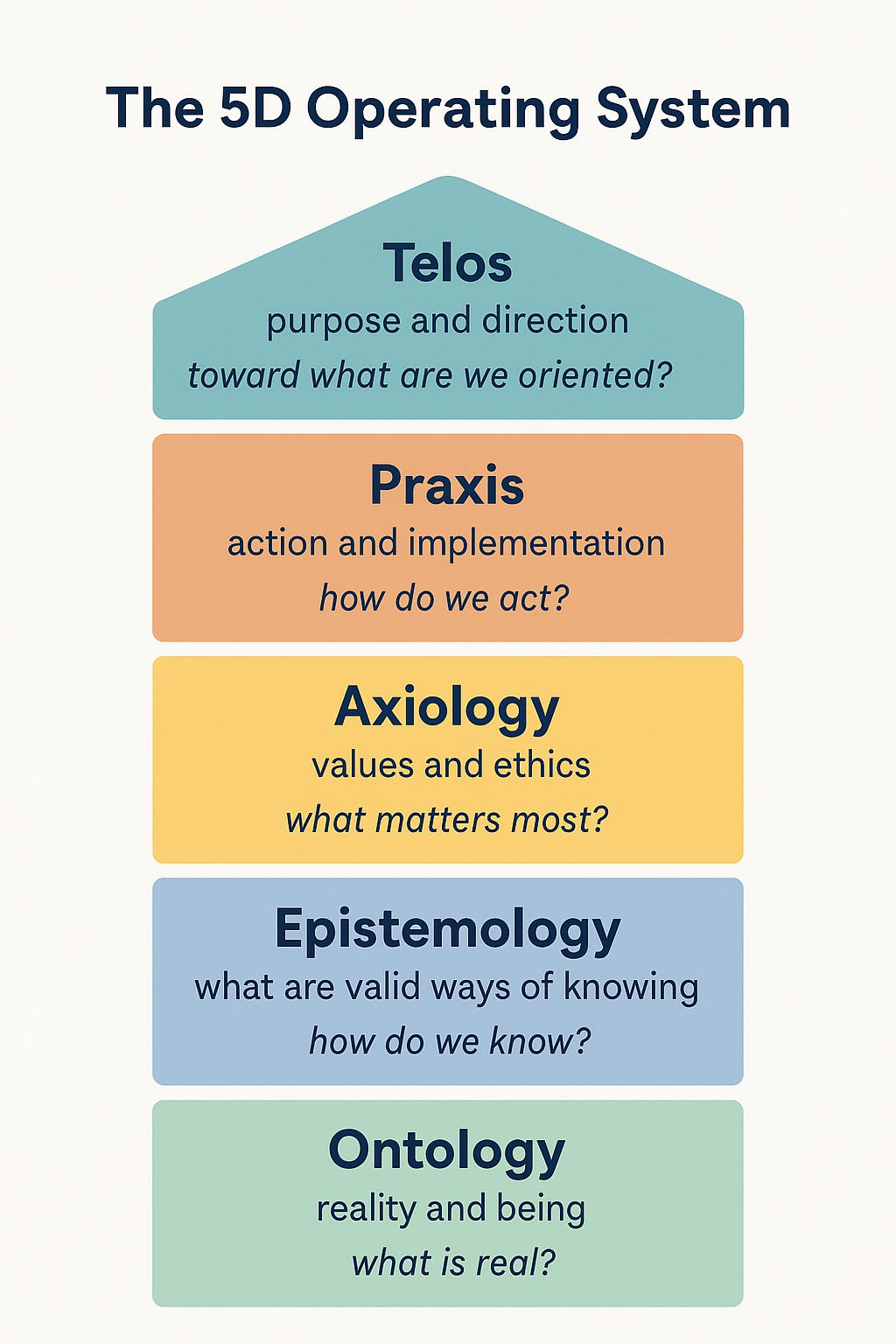
The Five-Dimensional Metatheory organizes sensemaking around five core dimensions: ontology, epistemology, axiology, praxis, and telos. Each dimension addresses a distinct but interrelated aspect of how individuals and systems engage with the world.
Ontology concerns assumptions about what exists and what kinds of entities or structures are real. Organizations implicitly adopt ontologies every day. Some treat people as interchangeable resources, others as autonomous agents, relational beings, or sources of creativity. Some view organizations as machines, others as living systems or social fields. These ontological assumptions shape what leaders notice, what they ignore, and what kinds of change they believe are possible.
Epistemology concerns how knowledge is generated, validated, and shared. Every system privileges certain ways of knowing over others. Some rely heavily on quantitative metrics and third-person observation. Others emphasize lived experience, dialogue, intuition, or collective sensemaking. Epistemological conflicts often masquerade as disagreements about facts, when they are actually disagreements about what counts as legitimate knowledge.
Axiology concerns values—what is considered important, desirable, or worthy of protection. Values are often articulated in mission statements and codes of conduct, but they are most clearly revealed through everyday decisions, reward systems, and trade-offs. When espoused values diverge from enacted values, cynicism grows and trust erodes.
Praxis concerns how action unfolds in lived reality. It is not merely what people do, but how reflection, intention, values, and knowledge are translated into practice. Many systems adopt practices that contradict their stated values or assumptions, creating deep structural hypocrisy that undermines change efforts.
Telos concerns directionality and purpose. It addresses the question of what a system is ultimately oriented toward. Telos is deeper than goals or performance targets; it functions as an attractor that gives meaning to action over time. When telos is unclear, fragmented, or conflicting, organizations lose coherence and momentum.
The power of the 5D Metatheory lies not in treating these dimensions separately, but in examining how they interact. Ontology constrains what can be known. Epistemology shapes what is valued. Values influence action. Praxis feeds back into assumptions about reality. Telos orients the entire system. When these relationships are coherent, systems become adaptive and resilient. When they are not, dysfunction becomes inevitable.
The 5D Operating System: From Fragmentation to Coherence
The metaphor of an operating system is intentional. Just as a computer’s operating system governs how applications run, interact, and allocate resources, the five dimensions govern how strategies, cultures, leadership behaviors, and innovations emerge. When the operating system is unstable or internally contradictory, no amount of effort at the application level can fully compensate.
Leaders frequently attempt to “install” new initiatives—agile transformations, culture change programs, leadership competencies—without addressing the underlying operating system. The result is predictable. New practices are layered on top of old assumptions. Metrics contradict values. Purpose statements fail to influence daily decisions. Change becomes performative rather than transformational.
The 5D Metatheory provides a way to diagnose and redesign the operating system itself. By making ontological, epistemological, axiological, praxical, and teleological commitments explicit, leaders can see where misalignment is occurring and why seemingly rational interventions are failing. More importantly, they can begin to design change efforts that operate coherently across all five dimensions.
This shift—from treating problems as technical to treating them as systemic and meaning-based—is one of the defining leadership challenges of our time.
Implications for Organizational Change and Transformation
Change initiatives fail less often because of poor execution than because of dimensional misalignment. Organizations may introduce new methods while retaining outdated assumptions about people and systems. They may declare new values without changing incentive structures. They may pursue efficiency while claiming to value learning and innovation. These contradictions generate confusion, disengagement, and resistance.
Applying the 5D Metatheory to change efforts reveals why transformation requires more than technique. Sustainable change depends on shifts in how reality is understood, how knowledge is generated, what is valued, how action is enacted, and what the system is ultimately trying to become. When leaders work intentionally across these dimensions, change efforts gain depth and durability.
Rather than asking only “What should we do differently?”, the 5D framework invites deeper questions: What assumptions about reality need to shift? Whose knowledge is currently excluded? What values are actually being rewarded? How do our practices embody or contradict our aspirations? Toward what future are we truly oriented?
Implications for Leadership Development
Leadership development programs often focus on skills, competencies, and behaviors. While important, these approaches frequently neglect the deeper structures that shape how leaders interpret situations and make meaning. The 5D Metatheory expands the developmental horizon by enabling leaders to reflect simultaneously across multiple dimensions.
Leaders using the framework begin to notice their own ontological assumptions about authority, agency, and human nature. They become aware of their epistemological habits—what kinds of evidence they trust and which voices they discount. They surface implicit value hierarchies that shape their decisions. They examine how their actions align or conflict with their stated intentions. And they clarify the purposes that animate their leadership.
This multi-dimensional reflexivity supports adult development by moving previously unexamined assumptions from the background into conscious awareness. Leaders become more capable of holding complexity, navigating paradox, and acting with integrity in uncertain environments.
Conclusion: From Fragmented Action to Coherent Leadership
The challenges confronting leaders today are not simply more numerous than in previous eras; they are qualitatively different. They unfold across multiple time horizons, span institutional and national boundaries, and resist linear solutions. In such an environment, leadership can no longer be understood primarily as decision-making under uncertainty or the effective execution of strategy. It increasingly requires the capacity to work with the deeper structures that shape how meaning, value, knowledge, action, and purpose interact.
The Five-Dimensional Metatheory responds to this shift by offering a way to see beneath surface-level problems and interventions. It does not compete with existing leadership models, change methodologies, or strategic frameworks. Instead, it clarifies the conditions under which those tools succeed or fail. By making ontological assumptions visible, epistemological commitments explicit, value hierarchies examinable, practices coherent, and purposes transparent, the framework enables leaders to address the root causes of fragmentation rather than its symptoms.
One of the most significant implications of the 5D Metatheory is that many organizational challenges are not failures of competence or will, but failures of alignment. Systems drift when their underlying assumptions pull in different directions. Culture initiatives falter when values are articulated but not enacted. Strategy collapses when purpose is unclear or contradictory. Innovation stalls when ways of knowing are narrowed or exclusionary. In each case, the problem is not a lack of effort, but a lack of coherence across the dimensions that organize meaning and action.
The 5D framework reframes leadership as a fundamentally integrative practice. It invites leaders to move beyond reactive problem-solving toward a more reflective stance, one capable of holding paradox, navigating competing values, and acting with intentionality in the face of uncertainty. This form of leadership does not promise control over complex systems. Rather, it cultivates the capacity to engage complexity without denial, simplification, or fragmentation.
Importantly, the Five-Dimensional Metatheory is deliberately non-normative. It does not prescribe what leaders should value, what purposes organizations should pursue, or which worldviews ought to prevail. Instead, it creates the conditions for more honest and productive conversations about those questions. By surfacing assumptions that are often hidden or taken for granted, the framework allows individuals and institutions to take responsibility for the worlds they are actively creating.
As complexity becomes a defining feature of organizational life, the ability to align ontology, epistemology, axiology, praxis, and telos will increasingly distinguish adaptive systems from brittle ones. Leaders who can recognize dimensional misalignment, facilitate coherence, and design interventions that operate across multiple levels will be better equipped to guide their organizations through uncertainty without sacrificing integrity or purpose.