
©2026 Mohammed Raei
Executive Summary
Leadership development is a multibillion-dollar global industry, yet its outcomes remain persistently disappointing. Despite decades of research, increasingly sophisticated programs, and growing organizational investment, many leaders report little sustained developmental impact, while organizations continue to struggle with ineffective leadership, ethical failures, rigidity, and an inability to respond adaptively to complexity. This white paper argues that these failures are not primarily due to poor program design, insufficient training hours, or weak facilitation. Rather, they stem from deep structural mismatches across five irreducible dimensions: ontology, epistemology, axiology, praxis, and telos.
Using the 5D metatheory as an analytic lens, this paper shows how leadership development initiatives routinely collapse complex developmental phenomena into narrow instrumental logics. Programs frequently assume static ontologies of the leader, privilege limited ways of knowing, import unexamined values, deploy misaligned practices, and operate under contradictory or implicit purposes. These misalignments generate predictable pathologies: superficial skill acquisition, short-lived behavior change, resistance to experimentation, performative compliance, and the reproduction of outdated leadership models.
Importantly, this paper does not claim that leadership development fails because actors are misguided, unethical, or incompetent. On the contrary, many failures occur precisely because well-intentioned initiatives are embedded within institutional structures that are developmentally incompatible. The argument advanced here is structural, not moral.
The contribution of this paper is not another leadership model or competency framework. Instead, it offers a metatheoretical diagnostic that allows organizations, designers, and scholars to see why leadership development fails at a systemic level. By making the five dimensions explicit, the paper demonstrates how many initiatives are structurally incapable of producing deep, sustained development, regardless of investment or sophistication.
The paper concludes by outlining the conditions under which leadership development could plausibly succeed, reframing development not as a programmatic intervention but as an organizational capacity rooted in metatheoretical coherence.
1. Introduction: The Persistent Failure of Leadership Development
Leadership development has become one of the most institutionalized interventions in modern organizations. Corporations, governments, NGOs, and universities invest heavily in programs designed to cultivate leadership capacity. These initiatives range from short workshops and competency frameworks to multi‑year executive programs and coaching engagements. Despite this proliferation, dissatisfaction remains widespread.
Empirical studies repeatedly show weak links between leadership training and organizational performance. Participants often report that programs are interesting but not transformative, while organizations struggle to demonstrate return on investment. More troublingly, leadership failures continue to manifest in predictable forms: ethical scandals, inability to manage complexity, disengaged employees, and brittle responses to uncertainty.
Common explanations for this failure tend to focus on surface‑level issues. Some argue that leadership development is too theoretical and insufficiently practical. Others claim it is overly generic, poorly facilitated, or disconnected from strategy. While these critiques contain elements of truth, they fail to explain why similar problems recur across vastly different contexts, sectors, and program designs.
This paper advances a deeper claim: leadership development fails because it is rarely designed with a coherent metatheoretical foundation. Programs implicitly assume answers to fundamental questions about reality, knowledge, value, action, and purpose without making those assumptions explicit or coherent. As a result, leadership development operates as a fragmented assemblage rather than an integrated developmental system.
The 5D metatheory provides a way to surface these hidden assumptions and to understand failure not as accidental but as structurally produced.
2. The 5D Metatheory as an Analytic Framework
The 5D metatheory distinguishes five irreducible dimensions that are present in any theory, practice, or intervention, whether explicitly acknowledged or not. These dimensions are analytically distinct but always entangled in practice. Failure arises not from the presence of any single dimension, but from incoherence and misalignment across them.
- Ontology concerns what is assumed to exist and what kind of beings leaders and organizations are.
- Epistemology concerns how knowledge about leadership is generated, validated, and privileged.
- Axiology concerns values, including what is considered good, desirable, or legitimate in leadership.
- Praxis concerns how leadership development is enacted in practice through methods, tools, and interventions.
- Telos concerns purpose, direction, and the implicit or explicit ends that leadership development serves.
The central claim of the 5D metatheory is that leadership development failure is rarely caused by deficiencies within a single dimension. Instead, failure emerges when initiatives are designed with partial sophistication—strong in one or two dimensions—while remaining naïve or contradictory in others. This produces interventions that appear coherent locally but are incoherent systemically.
The table below is intended as an integrative diagnostic rather than a classificatory device. It should not be read as suggesting that any single assumption or design choice is inherently wrong in isolation. Instead, the table surfaces how leadership development initiatives routinely combine assumptions, methods, and purposes that are locally reasonable yet systemically incompatible. The failure modes identified emerge precisely from these cross-dimensional mismatches, not from a lack of good intent, expertise, or investment.
Table 1. Leadership Development Failure Through a 5D Lens
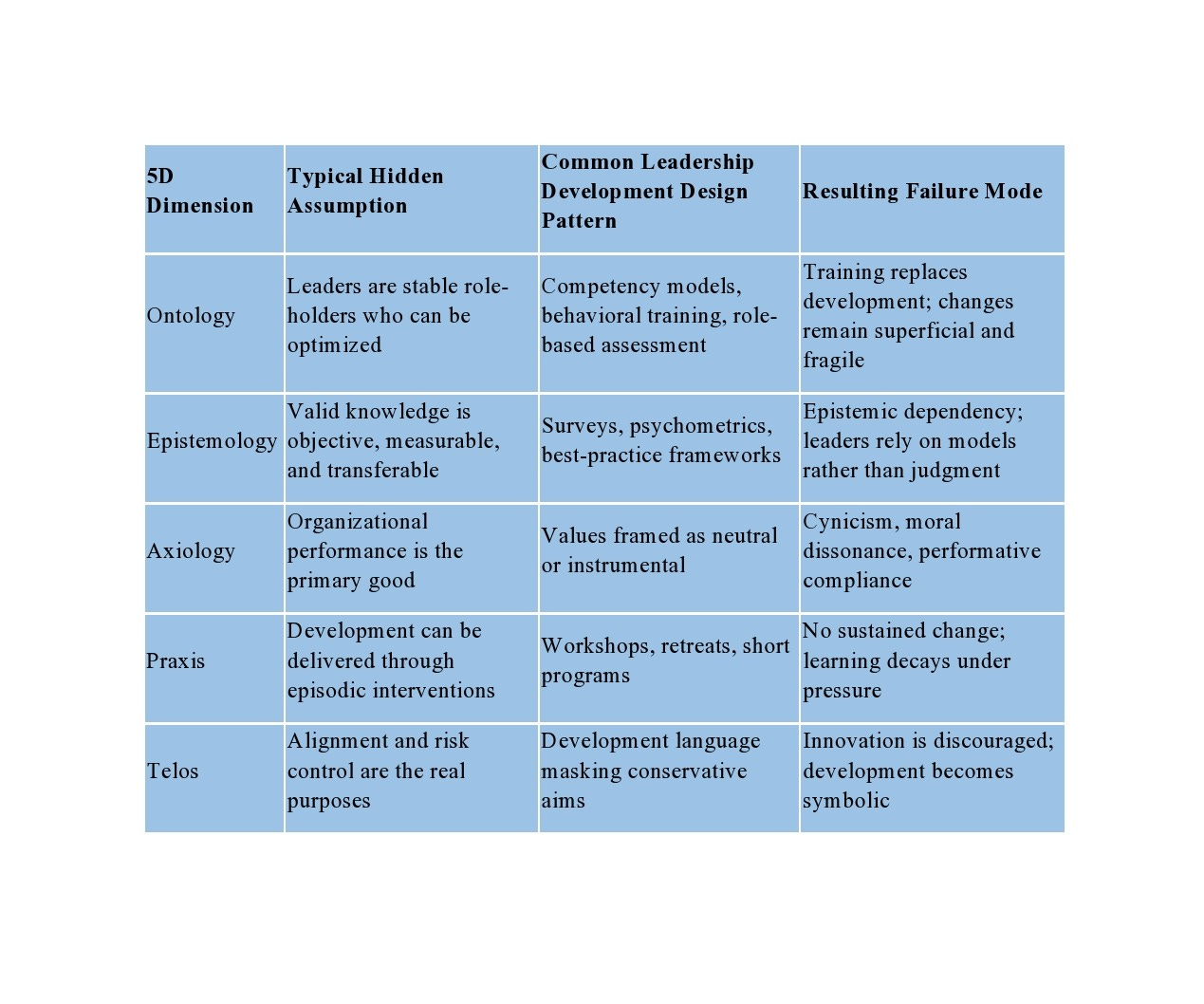
This table makes visible what is often implicit: leadership development programs rarely fail because they lack content or effort, but because they are built on incompatible assumptions about what leaders are, how they learn, what matters, how change occurs, and why development is undertaken at all.
Table 2. Why Common “Fixes” to Leadership Development Failure Often Make Things Worse
The table below traces a recurring pattern in leadership development redesign efforts. When initial programs fail, organizations frequently respond by intensifying or refining existing approaches rather than revisiting their underlying metatheoretical assumptions. These second-order responses are typically rational within a narrow frame, yet they often deepen the very failures they are meant to address.
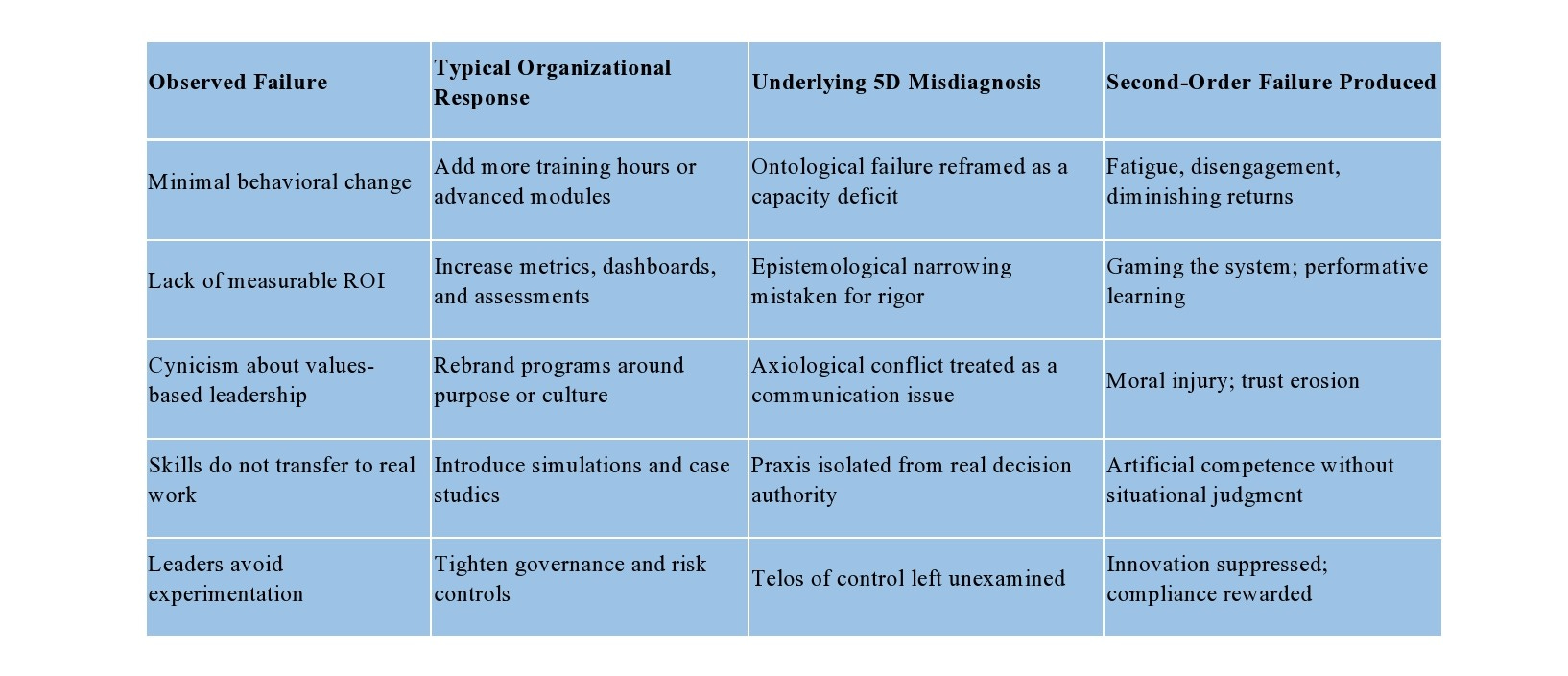
This pattern explains why leadership development frequently enters cycles of reform without transformation. Each redesign appears sensible when viewed within a single dimension, yet collectively these responses reinforce the same structural conditions that prevent genuine development from occurring.
3. Ontological Failures: Treating Leaders as Static Objects
At the ontological level, most leadership development programs implicitly treat leaders as static entities rather than as dynamically developing beings. Leaders are framed as role occupants, competency holders, or behavioral performers. Development, in this view, means adding skills or correcting deficits.
This static ontology produces several failure modes. First, it reduces leadership to a set of observable behaviors detached from identity, meaning‑making, and ways of being. Second, it assumes that the same leadership capacities can be universally defined and transferred across contexts. Third, it ignores developmental discontinuities, such as qualitative shifts in how individuals perceive themselves, others, and systems.
When leadership development is grounded in a static ontology, interventions default to training rather than development. Workshops, simulations, and assessments are designed to optimize performance within an existing frame, not to transform the frame itself. This explains why participants often report temporary improvements that quickly dissipate under real‑world pressure.
Moreover, organizations themselves are often treated ontologically as machines rather than as complex adaptive systems. Leadership development is expected to produce predictable outputs in the form of compliant, high‑performing leaders. This mechanistic ontology clashes with the lived reality of ambiguity, emergence, and nonlinearity, setting leaders up for frustration and failure.
Without an explicit developmental ontology, leadership development cannot reliably produce developmental outcomes.
4. Epistemological Failures: Narrow Ways of Knowing Leadership
Leadership development also fails due to epistemological narrowing. Most programs privilege particular forms of knowledge while marginalizing others. Quantitative assessments, competency models, and standardized frameworks are often treated as authoritative, while experiential, embodied, relational, and intuitive ways of knowing are secondary or excluded.
This epistemological bias has several consequences. First, it encourages leaders to externalize authority, relying on models and metrics rather than developing their own judgment. Second, it creates a false sense of objectivity, masking the interpretive and value‑laden nature of leadership knowledge. Third, it delegitimizes forms of knowing that are essential for navigating complexity, such as sense‑making, moral discernment, and contextual intuition.
Many leadership programs emphasize “evidence‑based” practice without interrogating what counts as evidence. This often leads to the uncritical application of research derived from narrow populations, simplified variables, or decontextualized settings. Leaders are taught what works on average rather than how to inquire skillfully into their own situations.
The result is epistemic dependency rather than epistemic maturity. Leaders become fluent in leadership language without developing the capacity to generate knowledge in action. This gap becomes particularly visible in novel or crisis situations, where predefined frameworks fail and leaders are left without epistemological grounding.
5. Axiological Failures: Smuggled and Conflicting Values
Values are always present in leadership development, whether acknowledged or not. Yet axiology is one of the least examined dimensions in leadership programs. Values are often smuggled in under the guise of neutrality, best practice, or organizational necessity.
Many programs implicitly prioritize values such as efficiency, control, growth, and performance, even when they explicitly claim to promote authenticity, inclusion, or well‑being. This creates internal contradictions that participants experience as cynicism or dissonance. Leaders are encouraged to be reflective and ethical, but rewarded for compliance and short‑term results.
In some cases, leadership development adopts emancipatory language while serving instrumental ends. Concepts such as purpose, mindfulness, or servant leadership are introduced without addressing the organizational structures that constrain their enactment. The result is moral injury rather than empowerment.
Axiological confusion also arises when leadership development is outsourced or standardized across diverse cultural contexts. Values embedded in program design may clash with local norms, identities, or moral frameworks, leading to resistance or superficial adoption.
Without explicit axiological reflexivity, leadership development risks becoming a vehicle for ideological reproduction rather than genuine development.
6. Praxis Failures: Misaligned Methods and Interventions
Praxis refers to how leadership development is enacted in practice. Even when ontological, epistemological, and axiological assumptions are partially sound, failure often occurs at the level of praxis due to misalignment.
A common praxis failure is the overreliance on episodic interventions. Workshops, retreats, and short programs are expected to produce lasting change despite minimal integration into daily work. Development is treated as an event rather than a process.
Another failure arises from the separation of learning from real decision‑making. Leaders practice skills in artificial environments but are not supported in experimenting within their actual organizational constraints. Fear of failure, risk aversion, and performance management systems actively undermine developmental practice.
Praxis is also constrained by facilitation models that position the facilitator as expert and participants as recipients. This reinforces dependency and discourages agency. Even coaching interventions can reproduce this dynamic if they focus on optimization rather than inquiry.
Effective praxis requires alignment with the other dimensions. Without an ontological commitment to development, an epistemology that values inquiry, and an axiology that legitimizes learning through error, no amount of methodological sophistication can succeed.
7. Telos Failures: Confused or Hidden Purposes
Perhaps the most consequential failure in leadership development lies at the level of telos. Programs often operate with multiple, conflicting purposes that are never reconciled. Leadership development is expected to serve individual growth, organizational performance, cultural change, and risk management simultaneously.
In many organizations, the dominant telos is control rather than development. Leadership programs function as mechanisms to align leaders with existing strategies and norms, not to question or transform them. Developmental language masks a fundamentally conservative purpose.
When telos is unclear or contradictory, participants receive mixed signals. They are encouraged to be adaptive and innovative, but punished for deviating from established practices. Over time, leaders learn that real development is unsafe.
A genuinely developmental telos would treat leadership development as a means of increasing an organization’s capacity to learn, adapt, and evolve. This requires tolerating uncertainty, dissent, and short‑term inefficiency. Few organizations are willing to make this commitment explicitly.
Without clarity of purpose, leadership development defaults to symbolic activity rather than transformational work.
8. Cross‑Dimensional Misalignment and Systemic Failure
The most damaging failures occur not within individual dimensions but across them. Leadership development often exhibits local coherence but global incoherence. For example, a program may espouse a developmental ontology while operating under a performance‑driven telos, or promote reflective practice within a risk‑averse culture.
These cross‑dimensional misalignments create double binds for participants. Leaders are asked to change without permission to change the conditions that require change. Over time, this produces disengagement, burnout, or strategic compliance.
From a 5D perspective, leadership development failure is not accidental. It is the predictable outcome of attempting development within structures that are ontologically static, epistemologically narrow, axiologically conflicted, pragmatically constrained, and teleologically conservative.
9. Why Leadership Development Reform Rarely Escapes Its Own Frame
Leadership development reform efforts are often sincere, data-informed, and well-resourced. Yet they repeatedly fail to generate qualitatively different outcomes. From a 5D metatheoretical perspective, this persistence of failure is not puzzling; it is structurally predictable.
Most reform initiatives operate within what can be described as a closed developmental frame. Problems are diagnosed using the same ontological, epistemological, axiological, and teleological assumptions that produced the original failure. As a result, reform becomes a process of intensification rather than transformation. More content is added, metrics are refined, facilitators are upgraded, and narratives are refreshed, while the underlying frame remains untouched.
Ontologically, reform efforts tend to preserve a view of leaders as improvable performers rather than as developing meaning-makers. When programs fail to produce depth, the response is to increase exposure or sophistication rather than to question whether the very conception of the leader is inadequate for developmental aims. Development is thus pursued without a developmental ontology.
Epistemologically, reform privileges better measurement over better inquiry. Weak outcomes are interpreted as evidence gaps rather than as signals of epistemic mismatch. This leads to a proliferation of assessments, dashboards, and evidence-based justifications that increase surface legitimacy while further constraining leaders’ capacity to generate knowledge in action.
Axiologically, reform often substitutes articulation for resolution. Conflicting values—such as care versus performance, learning versus control, or ethics versus expediency—are addressed through reframing and communication rather than through structural choice. The appearance of value alignment increases, while lived contradictions intensify.
At the level of praxis, reform focuses on method substitution. When workshops fail, simulations are introduced. When simulations fail, coaching is added. When coaching fails, digital platforms are deployed. Each move appears progressive, yet all remain constrained by the same organizational conditions that inhibit experimentation, error, and genuine learning.
Most decisively, reform rarely interrogates telos. Leadership development continues to serve unexamined purposes such as alignment, risk mitigation, and managerial control, even when it adopts the language of transformation. As long as the dominant telos remains conservative, reform efforts will reliably reproduce conservative outcomes.
From a 5D perspective, leadership development reform fails not because organizations resist change, but because they attempt to achieve development without changing the conditions under which development is possible. Escaping this frame requires metatheoretical reflexivity: the capacity to take the assumptions of leadership development itself as an object of inquiry.
10. Implications for Rethinking Leadership Development
The implication of this analysis is not that leadership development should be abandoned, but that it must be fundamentally rethought. Programs must begin with explicit metatheoretical clarity rather than imported models or best practices.
Organizations need to ask difficult questions: What kind of beings do we believe leaders are? What ways of knowing do we legitimize? What values are non‑negotiable? What practices are actually supported? And what is leadership development ultimately for?
Without engaging these questions across all five dimensions, leadership development will continue to produce disappointing results regardless of investment.
11. Conclusion
Leadership development often fails not because it is poorly executed, but because it is conceptually incoherent. The 5D metatheory reveals that failure emerges from deep misalignments across ontology, epistemology, axiology, praxis, and telos.
By making these dimensions explicit, the 5D framework offers a way to diagnose failure without moralizing or oversimplifying. More importantly, it provides a foundation for redesigning leadership development as a genuinely developmental, reflexive, and context‑sensitive practice.
Until leadership development confronts its own metatheoretical assumptions, it will remain an industry that promises transformation while reliably reproducing the status quo.