
©2026 Mohammed Raei
Innovation Is Still Poorly Understood
Innovation is one of the most frequently invoked concepts in modern economic and organizational life. Yet despite the abundance of frameworks, the structural dynamics of innovation remain surprisingly under-theorized. Much of the field still relies on binary distinctions — incremental versus radical, sustaining versus disruptive, exploration versus exploitation. These distinctions capture differences in intensity, but they flatten the multi-scale nature of innovation into static categories.
In practice, innovation rarely behaves in binary form. Small changes sometimes transform entire systems. Large initiatives often produce only marginal effects. Innovations migrate across domains, amplify through unexpected pathways, and embed themselves in infrastructures over time. What ultimately determines impact is not simply novelty or ambition, but structural scale, systemic position, and the capacity to cascade.
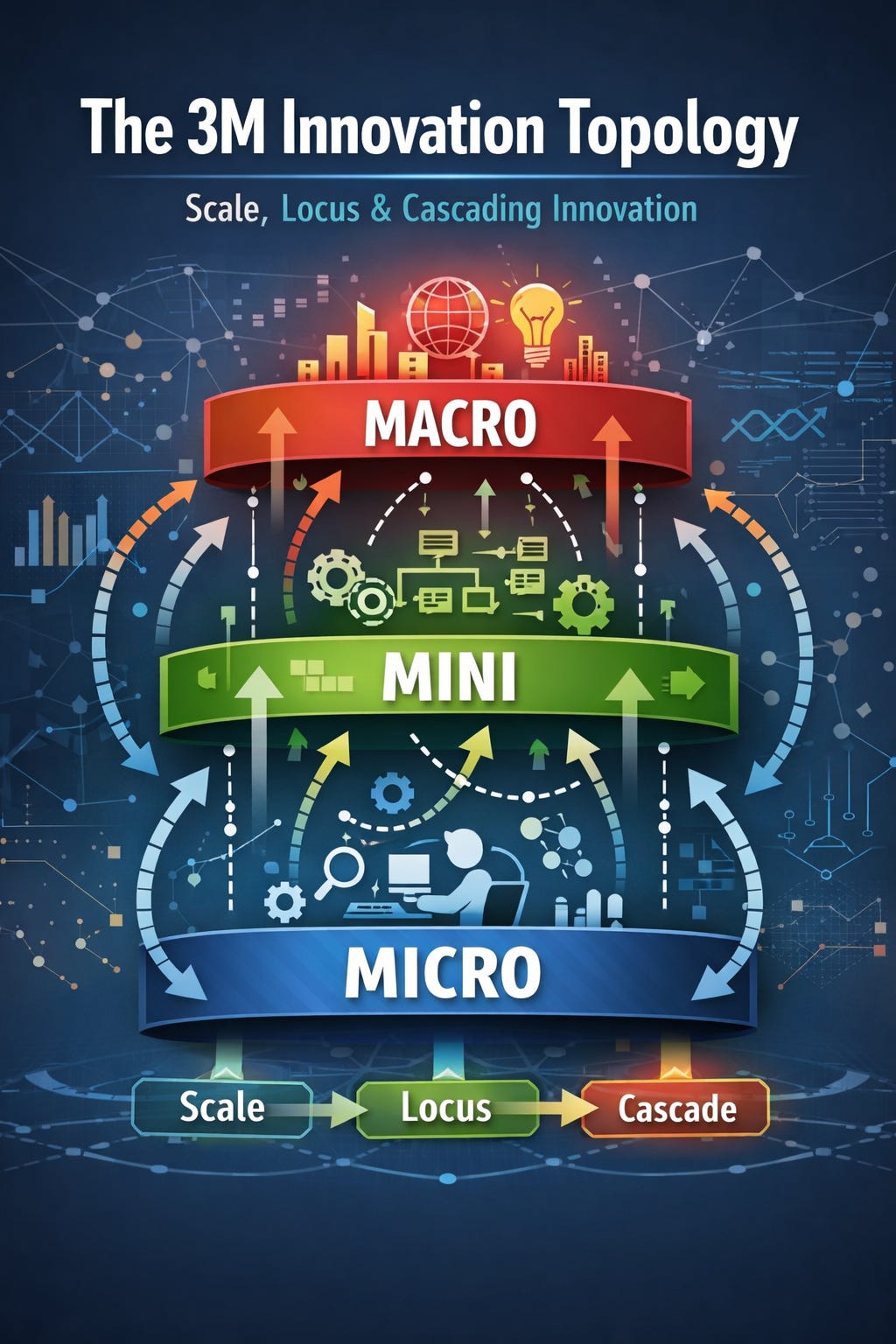
The M3 Innovation Topology begins from this premise. It proposes that innovation should be understood as a multi-scale phenomenon defined by structural magnitude, locus, and cascading dynamics. Rather than classifying innovations into fixed types, it maps how they move and interact across systems. Where typologies sort innovations into categories, a topology maps movement — how innovations travel across scales, occupy different structural positions, and generate cascading effects over time.
This framework is transdomain by design. The same structural dynamics that govern innovation in biological systems appear in semiconductor design, healthcare delivery, organizational change, and economic transformation. Once seen through the lens of scale and locus, these domains reveal deep structural parallels.
Beyond Binary Innovation Thinking
Most established innovation frameworks are built around binary distinctions. They assume that innovation falls into one of two primary forms: incremental or radical, sustaining or disruptive. While these distinctions offer conceptual clarity, they obscure the structural realities of how innovation unfolds.
Binary models collapse scale into intensity. A change is assumed to be either small or large, minor or transformative. Yet intensity alone rarely predicts systemic impact. A seemingly minor adjustment introduced at a structurally central point in a system can produce sweeping consequences. Conversely, highly visible initiatives may generate only superficial change when introduced at peripheral loci.
Binary typologies also treat innovation as static. They classify innovations at the moment of introduction but do not track how they propagate, amplify, or embed across systems over time. Nor do they capture how innovations move across domains, producing effects far beyond their original context. A more precise framework must therefore account simultaneously for structural scale, systemic position, and cascading potential.
Scale Without Confusion: Not a Levels-of-Analysis Model
The M3 Innovation Topology differentiates innovation across three structural scales: micro, mini, and macro. These terms are easily mistaken for traditional levels of analysis such as individual(micro), team (meso), and organizational or societal (macro). This interpretation misses the framework’s central point.
The topology does not classify innovation by where it occurs. It classifies innovation by the scale of its structural impact. Each type of innovation can originate at any level of analysis.
A single researcher may introduce a macro innovation that reshapes an entire field. A national institution may implement only micro adjustments to existing procedures. A large organization may launch a sweeping initiative that produces only local refinement. Structural scale is determined not by the size of the actor but by the magnitude and cascading reach of the innovation itself.
Micro innovations refine or enhance existing practices and capabilities. Mini innovations reconfigure systems, workflows, and coordination architectures. Macro innovations transform paradigms or reorganize entire domains. These categories describe structural magnitude rather than organizational location. Understanding this distinction prevents a common misunderstanding: that innovation moves in a simple hierarchy from macro to mini to micro or in the reverse direction. In reality, innovation cascades in multiple directions and often emerges independently across scales.
The Missing Middle in Innovation Theory and Practice
One of the most persistent blind spots in both innovation theory and organizational practice is the relative neglect of the structural middle. Much of the literature polarizes around micro-level behavior and macro-level transformation, while the intermediate level of workflow architecture, governance design, and coordination protocol receives far less sustained attention.
Where this middle level does appear — in discussions of process or architectural innovation or in socio-technical transition models — it is often treated descriptively rather than as a primary locus of innovation design. Yet it is precisely at this mini level that most transformation efforts succeed or fail.
Organizations routinely invest in macro vision and micro capability while leaving the structural middle largely unchanged. They articulate ambitious strategies, train individuals, and introduce new tools, yet workflows, decision rights, and coordination mechanisms remain intact. When transformation initiatives stall, it is typically at this intermediate level that alignment breaks down. The neglect of the mini scale is therefore not merely theoretical; it has direct operational consequences.
Recognizing the structural importance of this middle scale helps explain why many large-scale initiatives fail to produce meaningful change and why modest but well-placed structural adjustments can yield disproportionate impact.
Cascading Is Not Linear
The M3 Innovation Topology rejects linear models of innovation diffusion and instead treats cascades as multi-directional and structurally contingent. Innovation may propagate upward from micro to macro, downward from macro to micro, laterally across peer systems, or through recursive feedback loops. Micro and mini innovations frequently emerge independently rather than as downstream effects of macro initiatives, and macro initiatives often fail to cascade when not supported by aligned innovation at other scales.
A clinician may develop a diagnostic shortcut that spreads across professional networks and eventually reshapes institutional practice. A regulatory change may force organizations and individuals to alter routines. Engineering techniques may diffuse laterally across firms within an industry. Most significant transformations involve combinations of bottom-up, top-down, and lateral cascades rather than a single directional flow.
Macro innovation does not automatically generate mini or micro innovation. Many large-scale initiatives remain rhetorical because they lack mechanisms for local adoption. Conversely, distributed micro and mini innovations can accumulate and eventually produce macro transformation without originating from a centralized vision. Innovation therefore behaves less like a ladder and more like a dynamic field of interacting changes.
Locus: Where Small Changes Become Large
If structural scale describes the magnitude of an innovation, locus describes its position within the system. Locus often determines whether an innovation remains contained or produces cascading transformation. Small changes introduced at structurally central points can reorganize entire systems.
Biological systems illustrate this principle with particular clarity. The genetic difference between closely related species may be small, yet the resulting phenotypic divergence can be profound. The explanation lies in locus. Changes affecting regulatory genes — those that influence the expression of many others — cascade through developmental pathways, producing large-scale effects. A minor variation at a high-leverage locus can reshape the organism as a whole.
Semiconductor design exhibits comparable dynamics. Two engineering modifications of equal size may differ dramatically in impact depending on where they occur within the architecture. Adjustments to peripheral features may yield modest gains. Changes to core instruction sets or memory hierarchies can transform performance across the entire system. A design modification affecting a small fraction of a chip can double efficiency if it occurs at a structurally central locus.
Healthcare systems provide similar examples. Introducing a new administrative form represents a contained mini innovation. Altering diagnostic thresholds for a common condition can reshape treatment pathways, insurance coverage, and population health outcomes. Both innovations may appear similar in scale, yet their loci determine their cascading potential.
These examples demonstrate a recurring structural lesson: magnitude alone rarely determines impact. Structural position does.
Variation Within Each Scale
Locus sensitivity operates not only across scales but within them. Two innovations of identical nominal scale may produce markedly different results depending on their structural position.
At the micro scale, one behavioral adjustment may remain local while another spreads widely through professional practice. At the mini scale, two organizational innovations may differ sharply in systemic effect. A minor workflow refinement may improve efficiency locally, while a redesign of coordination protocols can transform outcomes across an entire institution. In engineering, one architectural tweak may yield marginal improvement while another produces significant performance gains. Mini1 does not equal mini2; structural locus determines cascading reach.
Recognizing intra-scale variation allows for more precise identification of leverage points and helps explain why innovations of similar apparent magnitude produce vastly different consequences.
Diagnostic and Generative Uses
The M3 Innovation Topology functions both as an evaluative lens and as a generative design framework. In diagnostic mode, it allows leaders and analysts to map where innovation is occurring within a system and where it is absent. An organization may display strong macro ambition but limited micro experimentation, or abundant pilot projects without structural transformation. Mapping these patterns reveals imbalances and stalled cascades.
In generative mode, the topology becomes a design architecture. Leaders can intentionally align innovation across micro, mini, and macro scales and position it at high-leverage loci. Macro conceptual shifts can be paired with structural redesign and everyday practices that reinforce one another. When aligned, these elements create cascades that stabilize and amplify change.
Few innovation frameworks operate effectively in both analytic and generative capacities. The ability to diagnose existing patterns and design future cascades within a single conceptual structure makes the topology particularly useful in complex environments.
Granularity and Compatibility with Other Innovation Typologies
The M3 Innovation Topology does not replace existing typologies of innovation such as product, process, or business-model frameworks. Those models classify the form an innovation takes. The topology instead introduces a question of granularity: at what structural scale is the innovation operating, and where within the system is its locus?
Any given innovation type may exist at micro, mini, or macro granularity and may occupy loci with very different cascading potential. By adding structural scale and locus sensitivity, the topology provides a complementary layer that deepens rather than competes with existing classifications.
Seeing What Was Always There
Many transformation efforts falter for reasons that remain poorly articulated. Organizations oscillate between grand vision and individual capability while leaving the structural middle largely untouched. Large initiatives are launched, training programs are deployed, and new tools are introduced, yet workflows and coordination architectures remain intact. When change fails to materialize, the causes appear diffuse or elusive.
Seen topologically, the pattern becomes clearer. Innovation succeeds or fails not only because of its ambition or ingenuity but because of where it occurs within a system and how it cascades across scales. Small changes introduced at high-leverage loci can reorganize entire systems, while sweeping initiatives introduced at peripheral points dissipate with little effect. The structural middle — where coordination, governance, and workflow actually reside — often determines whether transformation stabilizes or stalls.
To view innovation in this way is to shift from thinking in terms of isolated breakthroughs to thinking in terms of structural position and cascading potential. Once this shift occurs, certain patterns become difficult to ignore. What once appeared as uneven execution or resistance begins to reveal itself as misaligned scale, misplaced locus, or stalled cascade. Innovation, seen topologically, is less a matter of isolated creativity than of structural leverage within complex systems.