
©2026Mohammed Raei
Executive Summary
Contemporary coaching increasingly encounters clients whose challenges cannot be adequately addressed through goal-setting, behavioral change, or cognitive reframing alone. Issues of identity fragmentation, cultural conditioning, existential meaning, and transpersonal experience require a more integrative, developmentally sensitive framework.
The Many Selves Coaching Model responds to this need by offering a transdisciplinary architecture of selfhood that integrates psychological, cultural, developmental, and transpersonal dimensions into a coherent coaching ecology. Rather than privileging a single “true” self, the model recognizes multiple legitimate selves—each emerging under specific developmental, contextual, and phenomenological conditions.
This white paper articulates the theoretical foundations, practical applications, cultural adaptations, and ethical boundaries of the model, positioning it as a next-generation approach to transpersonal and integrative coaching.
1. From Transpersonal Psychology to Transdisciplinary Coaching
1.1 Historical Roots
Transpersonal coaching emerges from transpersonal psychology, which expanded psychology beyond pathology and ego functioning to include higher states, meaning, and spiritual experience. Early contributors emphasized that human development includes both vertical (transcendent) and horizontal (integrative) dimensions.
Over time, coaching adapted these insights, shifting emphasis from healing to development, agency, and conscious becoming. Recent decades have further expanded the field by integrating neuroscience, adult development, systems thinking, and cultural studies—necessitating a transdisciplinary rather than purely transpersonal lens.
1.2 The Assimilation–Accommodation Challenge
A key insight underpinning the Many Selves model is that without lived transpersonal experience, individuals tend to assimilate transpersonal language into existing meaning-making structures, rather than transforming those structures themselves.
This distinction is critical for coaches: symbolic adoption of “Higher Self” or “purpose” language does not equal developmental transformation. The model therefore emphasizes readiness, sequencing, and differentiation before integration.
2. The Architecture of the Many Selves
The Many Selves model does not posit multiple selves as metaphysical entities, but as distinct phenomenological and functional modes of self-experience, each accessible under specific conditions.
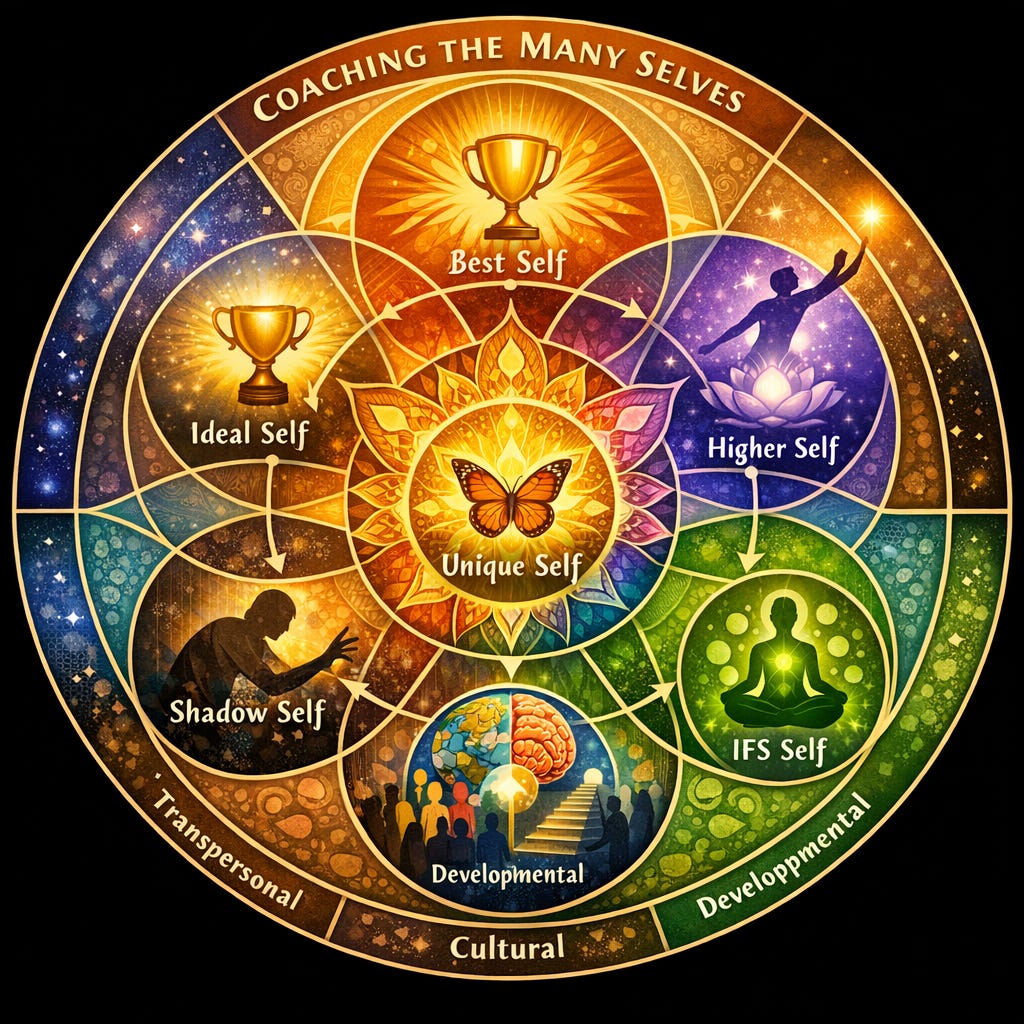
2.1 The Best Self — Strengths-in-Action Identity
The Best Self represents the individual at their highest demonstrated functioning, grounded in lived evidence rather than aspiration. Drawing on strengths-based psychology, it anchors identity in observable patterns of excellence
Coaching Function:
- Stabilizes identity
- Counters deficit-based self-concepts
- Serves as a reliable reference point during transition
Developmental Constraint:
Requires sufficient life or work experience to avoid becoming aspirational fantasy.
2.2 The Ideal Self — Aspirational Orientation
The Ideal Self reflects intrinsic aspiration rather than social obligation. When authentically accessed, it activates parasympathetic openness, supporting creativity and learning rather than threat-based striving
Coaching Function:
- Mobilizes motivation
- Orients developmental direction
- Reframes gaps as growth pathways
Key Distinction:
Ideal Self ≠ Ought Self. Coaches must help clients differentiate desire from internalized expectation.
2.3 The Shadow Self — Disowned Vitality
The Shadow Self includes rejected traits, emotions, desires, and identities—both “negative” and “golden.” Shadow material persists unconsciously, shaping behavior through projection, repetition, and self-sabotage
Coaching Function:
- Reclaims exiled energy
- Enables integration rather than suppression
- Prevents spiritual bypassing
Ethical Requirement:
Shadow work demands psychological safety and coach self-awareness. It must remain within coaching scope or be referred appropriately.
2.4 The Cultural Self — The Field of Meaning
The Cultural Self is not a stage but a pervasive meaning field shaping all other selves. Cultural norms define what is celebrated as “Best,” permitted as “Ideal,” and exiled into “Shadow”
Two Complementary Framings:
- Culture as Field — ever-present and constitutive
- Culture as Bridge — mediating personal shadow and transpersonal awareness
Coaching Function:
- Introduces systemic reflexivity
- Prevents cultural universalism
- Supports identity differentiation without cultural erasure
2.5 The IFS Self — Internal Leadership Capacity
Borrowed from Internal Family Systems, the IFS Self represents a naturally compassionate, curious, and regulating consciousness capable of leading internal parts
Key Contribution:
- Provides a secular, psychologically grounded entry point to self-leadership
- Enables conflict resolution without suppression
Developmental Role:
Often functions as a bridge between ego-based identity and transpersonal awareness.
2.6 The Higher Self — Transcendent Awareness
The Higher Self denotes universal, non-reactive consciousness characterized by clarity, compassion, and intuitive knowing. It is accessed through stillness, presence, and somatic awareness rather than effortful cognition
Coaching Function:
- Supports existential decision-making
- Holds paradox without premature closure
- Enables meaning-making beyond ego narratives
Key Risk:
Spiritual bypassing if accessed without sufficient ego integration.
2.7 The Unique Self — Enlightened Individuality
The Unique Self integrates universality and particularity: the idea that one’s distinct perspective, gifts, and wounds are not obstacles to transcendence but vehicles of expression.
Core Shift: From dissolving individuality → clarifying and expressing it consciously.
Coaching Function:
- Articulates vocation as inherent, not externally assigned
- Links healing, contribution, and evolutionary responsibility
3. Progression, Not Prescription
The model proposes a developmental progression:
Best → Ideal → IFS → Higher → Unique
However, this is not linear or mandatory. Coaches are encouraged to:
- Meet clients where they are
- Assess readiness across emotional, reflective, and narrative capacities
- Move fluidly while maintaining developmental integrity
4. Coach Capabilities and Ethical Depth
The Many Selves model places significant demands on the coach, including:
- Presence and nervous system regulation
- Psychological literacy (shadow, parts, projection)
- Transpersonal discernment without belief imposition
- Cultural reflexivity and humility
- Ongoing supervision and self-work
The meta-capacity required is dialectical holding—the ability to sustain paradox (personal/transpersonal, light/shadow, universal/unique) without collapse or simplification
5. Implications for Coaching Practice
- Repositions coaching as identity ecology work, not just goal achievement
- Integrates performance, healing, meaning, and contribution
- Offers a rigorous alternative to both purely instrumental coaching and ungrounded spirituality
- Aligns with ICF competencies while extending their conceptual depth
Conclusion
The Many Selves Coaching Model provides a coherent, developmentally sensitive, and culturally attuned framework for working with the full spectrum of human experience. By honoring both universality and irreducible uniqueness, it supports clients not only in becoming more effective—but more whole.